
Object Record
Images
Metadata
Title |
Automated Peptide Synthesizer |
Object Name |
Synthesizer, Peptide |
Object ID |
2008.043.002 |
Description |
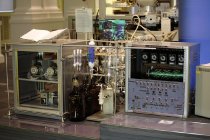
Instrument is in 3 main parts; part one is a square grey metal box with two shelves, small pump (Beckman) is on the lower shelf and two rotary selectors are on the top shelf; part two is a rack of various pieces of glassware including 6 bulbs and a reaction chamber that are attached to the pump and the rotary selectors by a number of thin plastic tubes; part three is the programmer unit, unit contains five timers, a tenor drum, and a control panel. Peptide Synthesis is the production of organic compounds, known as peptides, in which multiple amino acids are linked by peptide/amide bonds. Solid Phase Peptide Synthesis was developed by Dr. Robert B. Merrifield in the late 1960's at Rockefeller University. In SPPS, the peptide chain that is to be synthesized is chemically bonded to a solid support (usually a resin) that holds it while the synthesis process takes place. The technique allows for better yield then other methods, but is limited; SPPS usually has a limit of 70-100 amino acids. SPPS is now the most accepted method for creating peptides and proteins synthetically in a laboratory. |
Date |
1980s |
Dimensions |
H-22.75 W-21.75 D-15 inches |
Material |
Glass, Metal, Plastic, Rubber |
Search Terms |
Solid Phase Peptide Synthesis SPPS Peptide Synthesis Synthesized Condensation Compounds Organic Chemistry Merrifield, Robert Bruce |
Provenance |
Robert B. Merrifield was awarded the Nobel Prize in Chemistry in 1984 "for his development of methodology for chemical synthesis on a solid matrix." Peptide Synthesis is the process of synthetically creating peptide chains in a laboratory. There are two main types of Peptide Synthesis, Liquid-phase and Solid-phase (developed by Dr. Merrifield), although Solid-phase is the more accepted method. |